Learn
How much to transfer to your bills account each paycheck
The usual advice is to add up a year of bills, divide by your paychecks, and transfer that amount into the bills account every payday. It works, but you redo the math every time a bill changes. And paydays drift across the calendar, so the number that worked in March can leave rent short in June.
There’s an easier answer. Transfer all of it. Let the whole paycheck land in the bills account, then move out what the bills don’t need. The question stops being “how much goes in” and becomes “how much can leave,” and a forecast answers that for you.
Flip the direction
In the two-account system, every autopay draws from the bills account. Point your direct deposit there too. Now the bills account is the only place money arrives and the only place bills leave, which makes it easy to forecast.
The transfer goes the other way: from the bills account to the spending account, on payday. Whatever lands in spending is yours. The bills account never sees a grocery run, and the spending account never sees rent.
Put it all in and look at the line
You don’t need a calculator for this. You need three things written down and a chart.
- Today’s balance in the bills account. Just the number your bank shows.
- Your paychecks, as a repeating item. Amount and schedule, every two weeks or whatever yours is.
- Every bill, as a repeating item with its due date. Include the yearly ones, like car registration or an annual premium. Those are the ones that surprise people.
Then look at the balance forecasted forward. It climbs on each payday and steps down at each bill. The lowest point on that line is the money that’s spoken for. Everything above it is room.
Here’s the example from the two-account article: $1,430 every two weeks, $2,400 in the account today, and these bills.
| Bill | Amount | Due |
|---|---|---|
| Rent | $1,450 | the 1st |
| Netflix | $18 | the 5th |
| Phone | $70 | the 12th |
| Insurance | $140 | the 20th |
| Car payment | $385 | the 28th |
| Total | $2,063 | a month |
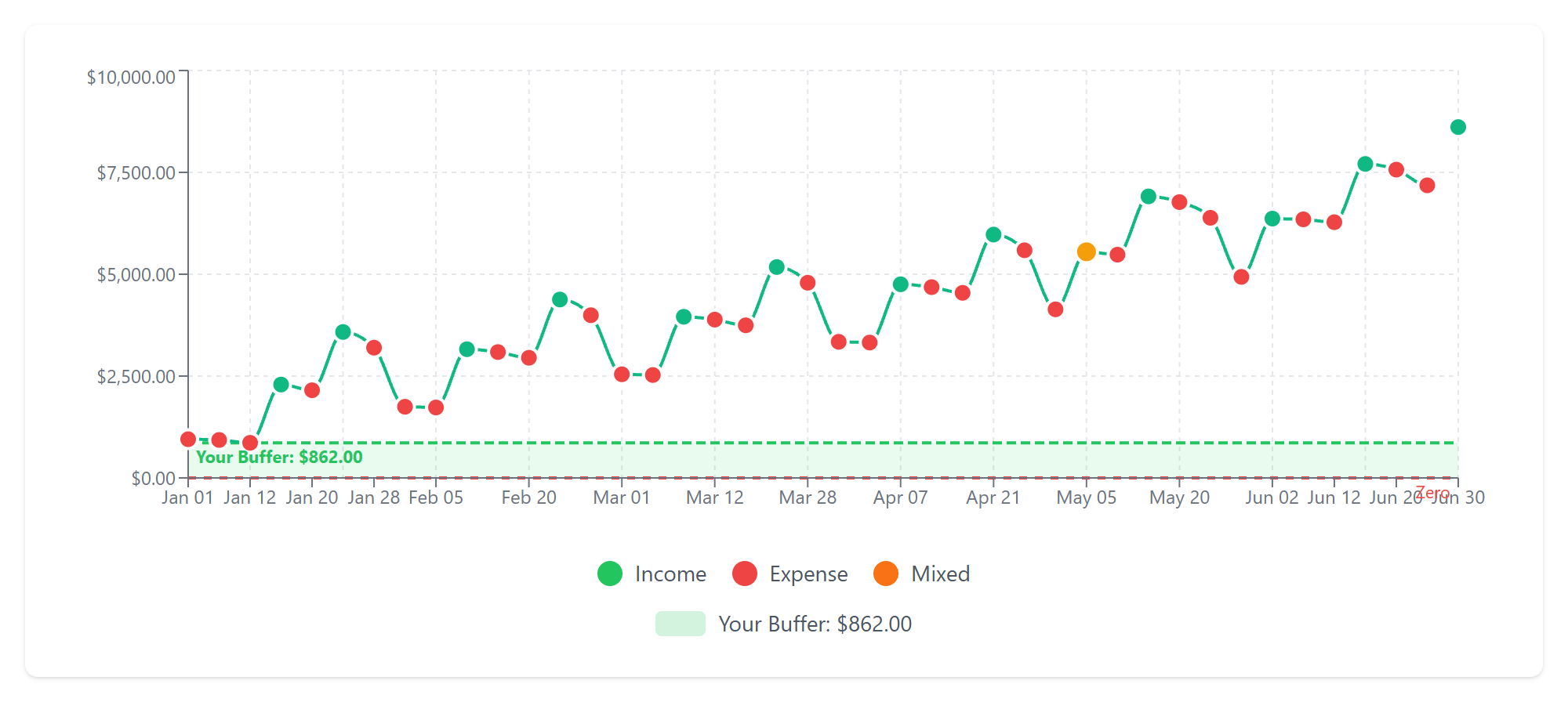
With nothing leaving, the account piles up about $1,000 a month. That pile is the spending money. The next step is finding out how much of it can leave each payday without the line touching zero.
Find the transfer by trying it
Add one more repeating item: a transfer to spending, on payday. Guess the amount. Then look at the line again and find the lowest point.
Try $500. In the tightest payday timing, the balance goes under zero on June 1, when rent lands before the second paycheck of the month. The line shows a red dip there, months ahead of time.
Try $470. The line holds. The lowest point is $235 on June 1, and it never goes lower across the whole year. That’s the number. You didn’t divide anything; you moved a number and watched the line.
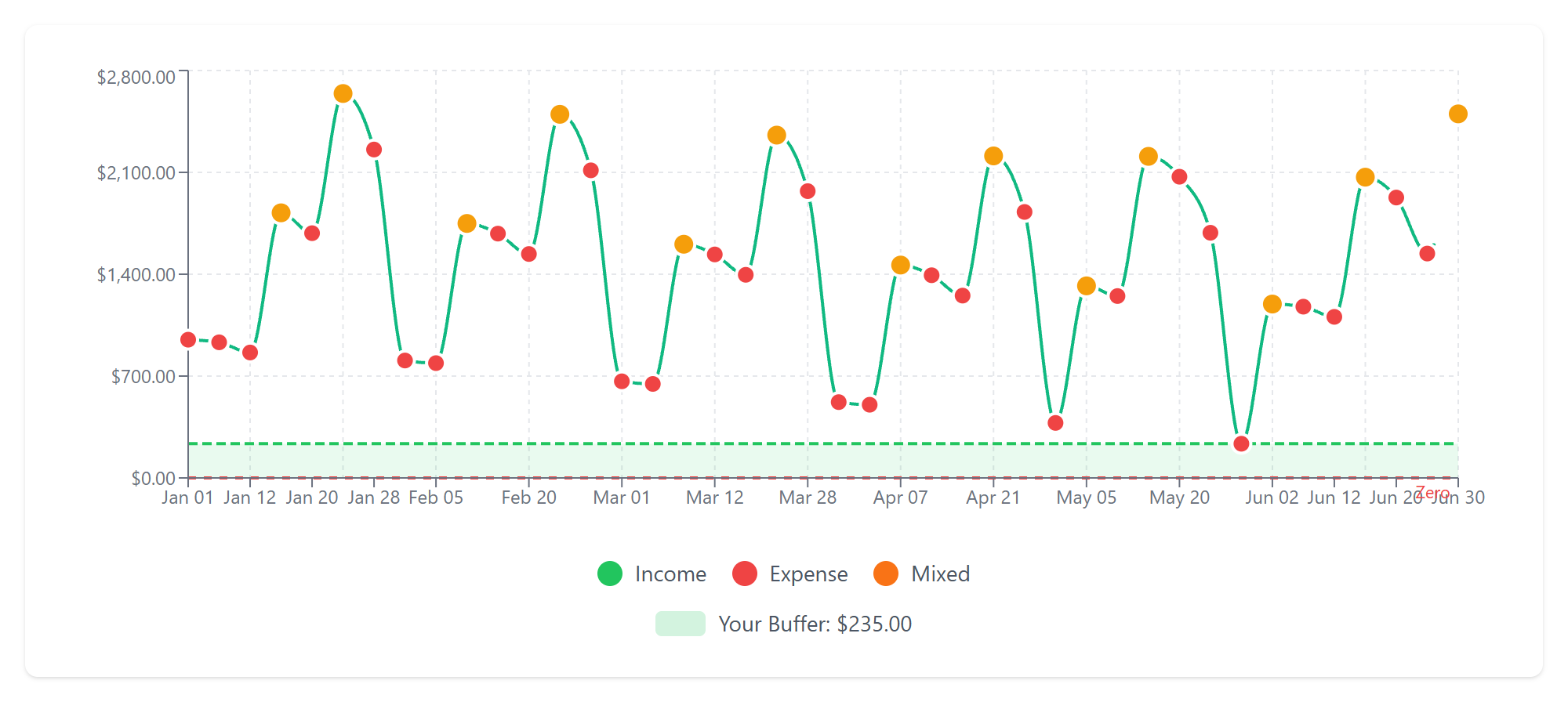
Three-paycheck months take care of themselves. The forecast counts the paydays that actually happen. The third check lands in the bills account and carries it through the months where rent comes before the first payday.
If the line never comes near zero, you’re leaving money in the wrong account. Raise the transfer until the low point is a few hundred dollars, a cushion for one surprise, and stop there.
Saving for something
The same move answers every “can I afford this” question. Say you want to put away $100 a week for a trip. Add it as a repeating item, then scroll forward and look.
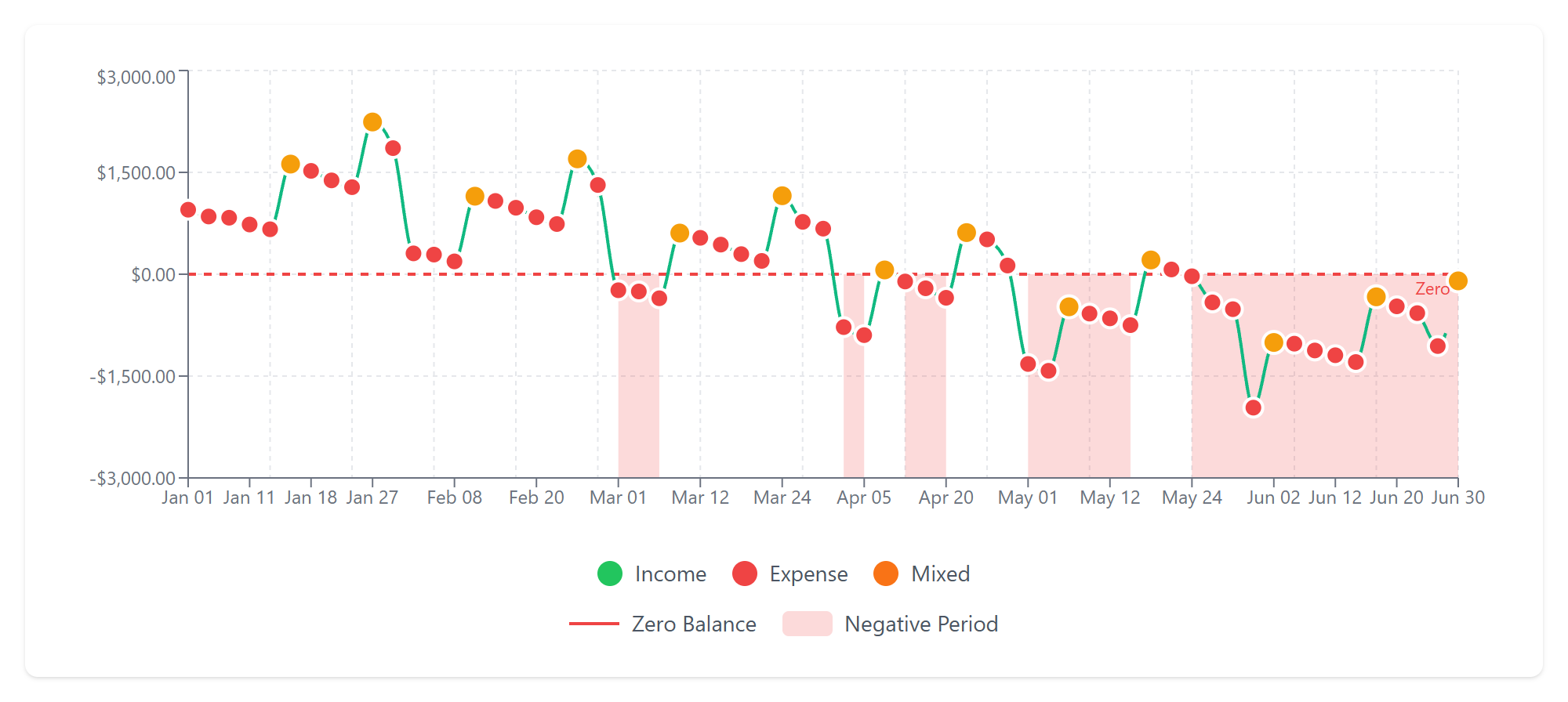
The line says no. So try it smaller. Drop the spending transfer to $400 and the trip to $25 a week, and the low point lands at $385 on June 1. Now it holds. The trip money comes out of the spending transfer, which is where it was always going to come from.
That’s the whole method for savings and investing too. Put the transfer in as a what-if, look at the forecast, and keep the number that keeps the line above zero.
When something changes
A bill goes up: change that one item and look at the line. If the low point is still comfortable, nothing else changes. If it dips, trim the transfer to spending by the same amount.
A raise: change the paycheck and look. The line climbs faster, and the extra room above the low point is yours to move out. Same for a bill that ends.
Once a season, glance at the lowest point for the months ahead. That one number is the whole status report.
Where SpokenFor fits
This is what SpokenFor is. You put in today’s balance, your paychecks, and your bills, and it draws the line and finds the low point. Add a transfer as a what-if and see whether it holds.